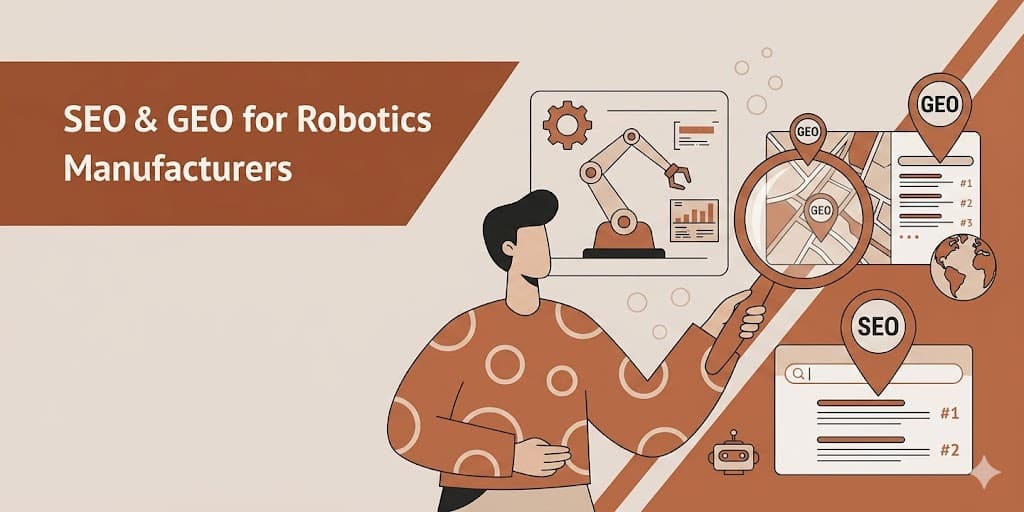
Industrial robotics has become a strategic focus for manufacturers and logistics operators dealing with labor shortages, production constraints, and escalating operational costs. Search represents the primary channel where organizations investigate how robotics solutions address these challenges. The emergence of generative AI platforms in search requires manufacturers to optimize for both traditional SEO and generative engine optimization (GEO), as buyers now pose complex, multi-step questions rather than simple keyword searches.
Robotics purchasing decisions involve extended timelines — typically six to 18 months — encompassing extensive research, internal evaluations, and cross-functional input before vendor consideration begins. Understanding the complete set of buying journeys is essential for building an effective strategy.
Key Takeaways
- Automation exploration initiates with operational obstacles rather than product specifications
- Multiple stakeholders participate in robotics decisions, each researching differently
- Specification-focused SEO overlooks early-stage research opportunities
- Search visibility should sustain influence throughout lengthy purchasing cycles — optimize for AI search as well as traditional rankings
1. Start with Operational Problems, Not Product Terms
Enterprise robotics purchasers rarely initiate searches targeting specific robot models. Research typically commences with operational challenges: labor shortages, throughput limitations, and cost or safety concerns.
Labor scarcity represents the primary catalyst for automation investments. Manufacturing in the United States contained over 400,000 open jobs in 2025, with projections indicating a potential 2.1 million worker shortage by 2030. Typical early searches include: "How to automate warehouse picking," "Warehouse labor shortage solutions," "Manufacturing automation strategies." These inquiries target business problem resolution rather than vendor identification — and they increasingly manifest as natural language questions through AI platforms.
2. Build Content for a Multi-Stakeholder Ecosystem
Enterprise robotics implementations represent complex, multi-party acquisitions. Consequently, robotics search patterns reflect broad ecosystem participation beyond individual end-purchasers.
- Engineering teams assess technical viability: integrating robotics with MES or ERP systems, robotic system reliability, machine tending automation architecture
- Operations leaders prioritize results: improving throughput, reducing labor dependency, scaling production capacity
- Procurement and finance teams examine investments: robotics ROI models, vendor comparisons, implementation costs and risks
- External stakeholders including integrators and distributors investigate technical documentation and platform capabilities
3. Align Content to Long Buying Cycles and the Full Journey
Robotics represents a significant investment category featuring prolonged decision horizons. Most automation purchasing timelines span six to eighteen months, prioritizing sustained visibility over immediate conversion opportunities.
Search behavior progresses through identifiable stages: early stage focuses on problem identification (labor shortages, production bottlenecks, rising costs), mid-stage explores solutions (robotic palletizing, robotic versus manual welding), and late stage covers planning and vendor evaluation (integration with WMS/MES/ERP, vendor comparisons).
4. Optimize for GEO and Measure What Actually Drives Impact
Generative AI fundamentally transforms discovery mechanisms. Buyers formulate intricate, multi-step inquiries expecting integrated responses rather than hyperlink compilations. Principles strengthening traditional SEO similarly enhance GEO performance: straightforward direct question responses, authoritative well-organized content, and natural language mirroring search patterns.
Meaningful performance indicators for robotics manufacturers encompass: pipeline originating from organic search, opportunities sourced through organic traffic, sales-qualified leads from SEO, deal value from organic-sourced leads, and brand citations and mentions within AI search outputs.
Influencing Automation Decisions Earlier
Automation choices involve complexity, developing progressively through multiple stakeholder participation with divergent priorities. Sustained visibility and relevance demand content addressing each audience segment and journey phase. Organizations achieving success build SEO strategies that shape demand by consistently maintaining visibility wherever automation decisions undergo evaluation.