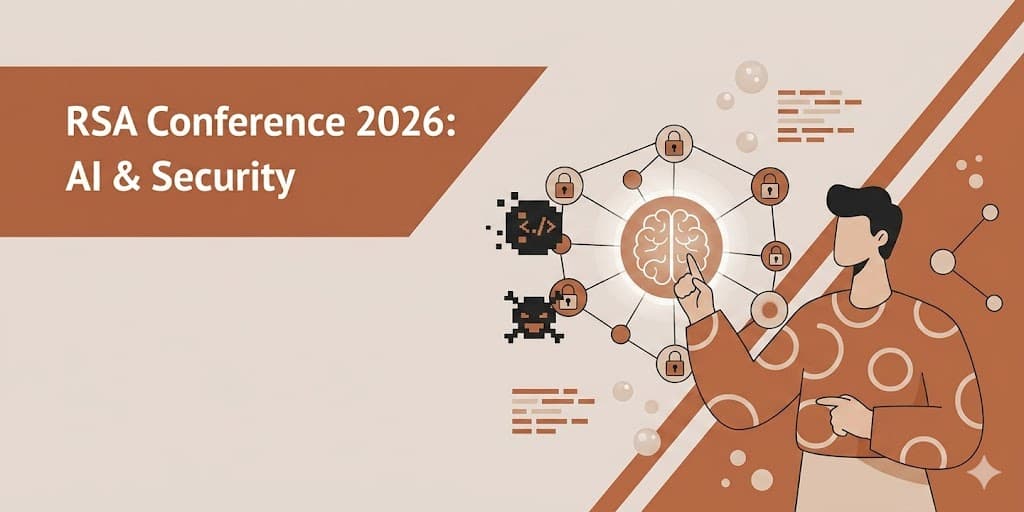
RSA Conference 2026 (April 6–8 in San Francisco) didn't feel like a glimpse of what's next. It felt like a check on what's already here.
Yes, AI dominated the conversation — that part isn't surprising. The surprise was how quickly 'AI' has become the default opener for everyone. When every company leads with some variation of AI-powered, AI-driven, agentic AI, the message stops differentiating. It turns into background noise.
That's the real takeaway: cybersecurity isn't just a technology race anymore. It's a fight for meaning, and most brands are still trying to win it with feature lists.
Key Takeaways from RSAC 2026
- AI is no longer a trend — it is the foundation of how security is being built and operated
- Concerns around attackers outpacing defenders continue to grow as AI adoption scales
- Complexity is increasing, not consolidating, as teams juggle more tools, more identities and a growing AI-driven attack surface
- Differentiation is breaking down, making narrative and perception more critical than ever
AI Isn't a Feature. It's the Operating Model
Nearly every major announcement at RSAC centered on AI. From agentic security platforms to AI-powered prioritization engines, the industry has fully pivoted. This shift is about much more than adding AI features — it is redefining how security is built and delivered.
A new wave of AI-native startups is emerging alongside established vendors racing to adapt. The definition of security itself is also evolving: autonomous agents, non-human identities and systems operating with increasing independence are changing the operating model entirely.
The Attacker Gap Is Widening
One theme surfaced throughout the week: attackers are outpacing defenders. It's not a new conversation, but AI is adding new urgency. Across sessions, media coverage and industry conversations, the same dynamics kept coming up:
- More stealth and persistence in attacks
- Faster iteration cycles for threat actors
- Lower barriers to entry for malicious actors
Complexity Isn't Going Away
Security teams are now managing more tools, more identities (human and non-human), and a rapidly expanding AI-driven attack surface. At the same time, new categories continue to emerge. The result is more complexity, more noise and more pressure on already-stretched teams.
The Real Shift: Cybersecurity Has a Narrative Problem
If you spent time analyzing the RSAC landscape, you realized it was a lot of the same conversations: agentic AI security, AI-native platforms, autonomous defense. Different logos, similar stories. The sameness creates a market where buyers are overwhelmed — even seasoned security leaders are struggling to decide where to place their bets.
What This Means for Marketing and Communications Leaders
For CMOs and communications leaders, this shift requires a different approach. You can't wait for the product roadmap to define your story. And traditional PR playbooks that prioritize moments over momentum are no longer enough.
You Have to Shape the Narrative
If your company is not actively framing how AI is changing security, someone else is doing it for you. And once that narrative takes hold, it becomes much harder to reposition.
You Have to Stand Out in a Sea of Sameness
When every company is talking about agentic AI, simply joining the conversation is not enough. You need a distinct, defensible point of view. What do you believe others are getting wrong? Where are others underestimating the risk? What makes your approach meaningfully different?
You Have to Show Up Earlier
Buyers aren't just relying on analyst reports or trade coverage. They're consuming a mix of media, peer insights and increasingly asking generative engines for answers, comparisons and recommendations. Visibility is no longer just about reach — it's about whether your perspective shows up in those early moments that shape consideration and influence pipeline.
What It Takes to Stand Out Now
- A clear, defensible point of view — not campaign messaging, but a real stance that calls out industry blind spots
- A media strategy built for influence — prioritizing placements that influence both human audiences and AI-driven discovery
- Data-driven storytelling that differentiates — using original data to validate a broader point of view and create multiple storylines
- Always-on presence — investing in consistent visibility, timely commentary and ongoing executive presence to build momentum
The Bottom Line
RSAC 2026 highlighted a growing gap between how quickly the industry is evolving and how slowly many brands are adapting their go-to-market approach. AI is accelerating everything: innovation, competition and noise. And in that environment, silence is not neutral. It is a risk.
The brands that stand out won't be the ones with the most features or the biggest announcements. They'll be the ones that define what matters, show up consistently and shape how buyers understand a rapidly changing market. Because in the age of AI security, the real question is no longer just whether your product works — but whether anyone understands why it matters.