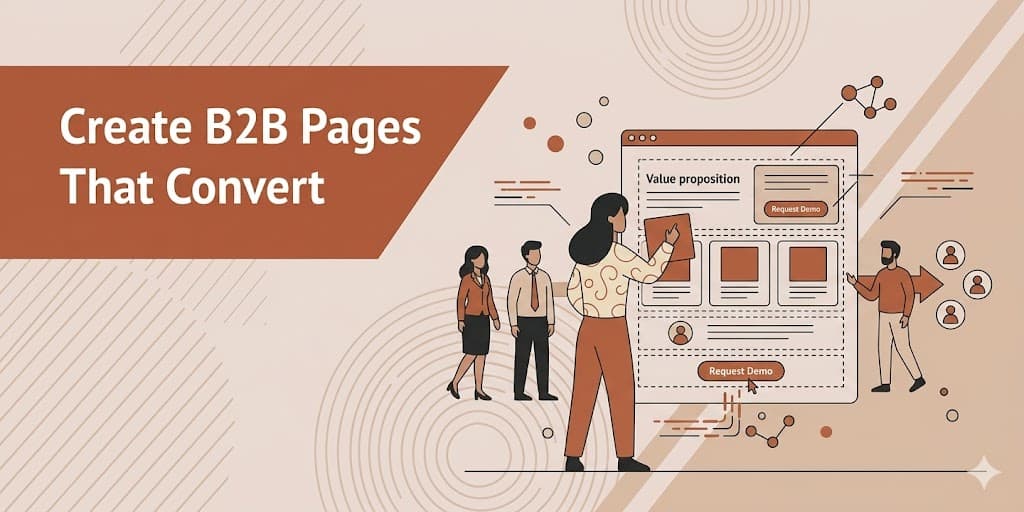
B2B landing pages serve as essential tools for businesses pursuing lead generation online. They enhance traffic conversions through organic and paid channels while enabling lead acquisition via form submissions. These pages deliver a refined user experience targeting mid-to-lower funnel audiences. However, poor optimization can repel prospective customers entirely.
Conversion Starts With Outcomes
Strong performance indicators include:
- Conversion Rate — measures how many visitors complete desired actions, typically form submissions; the average B2B conversion rate stands at 6.6% (SaaS: 3.8%, Financial Services: 8.3%, Health and Wellness: 5.1%)
- Cost Per Lead (CPL) — demonstrates lead acquisition efficiency; lower costs indicate superior targeting and message-market alignment
- Engagement Rate — tracks user interactions including clicks, scrolling, video watching; higher engagement signals resonant content
- Pageviews and Time on Page — time-on-page reveals attention levels; evaluate alongside conversion data for accurate interpretation
8 Proven Ways to Improve B2B Landing Page Conversion
1. Lead With the Pain
Headlines should mirror audience challenges and promise solutions. Incorporate statistics, concrete outcomes, and direct language. Effective approaches include asking questions, citing exact numbers, or describing actionable product benefits.
2. Design With Purpose
Graphics should align with professional branding and color schemes while promoting offerings. Visuals reinforce rather than distract — images boost content engagement by 80%. Employ branded graphics, white space, and color to establish trust and focus attention on CTAs. Avoid generic photography.
3. Optimize Across Devices
Mobile optimization is mandatory — 88% of users won't return following bad experiences. Pages loading in 2.4 seconds convert nearly twice as effectively; exceeding 3 seconds triggers 53% bounce rates.
4. Say More With Less
Average attention spans have declined from 2.5 minutes in 2004 to 47 seconds currently. Use clear headlines, bullet points, and brief paragraphs, maintaining 500–700 word counts for readability. Avoid complex terminology.
5. Use Data as Proof
Trust develops through credible statistics, benchmarks, and A/B testing insights validating messages and authority. 55% of companies incorporate A/B testing into landing pages. Dell achieved 300% sales increases through website implementation, substantially attributed to A/B testing success.
6. Make Your CTA Do the Heavy Lifting
Generic phrases like "Learn more" underperform significantly. CTAs should complete: "I want to..." Action verbs tied to value — "Get the Report," "Start My Trial" — can boost conversions by 202%. Ensure CTAs match page goals and visually distinguish themselves prominently.
7. Prioritize Content Above the Fold
Users dedicate 57% of attention above the fold. Lead with value propositions, include compelling visuals, and position forms or CTAs where viewers' eyes naturally land. Maximize above-the-fold content, positioning it leftward with forms rightward.
8. Align Design With the Funnel
Tailor design to campaign objectives. Nurture campaigns benefit from progressive forms; paid campaigns require keyword alignment. Paid media campaigns may incorporate specific assets; SEO or PPC pages should align content with targeted keywords.
Real Results: B2B Landing Page Success Stories
AHEAD
Supporting AHEAD's @Scale campaign involved constructing a high-impact landing page extending new creative assets across video, digital, and print channels. Results included 62 media placements, 3.9M+ impressions, and demonstrated audience-to-action conversion.
Magnetic
Magnetic partnered with Kubnal Bridge to reduce CPL and improve performance. Following copy refinement and keyword-paid campaign alignment, conversion rates increased from 0.6% to 3.75%, occasionally exceeding 5%.