
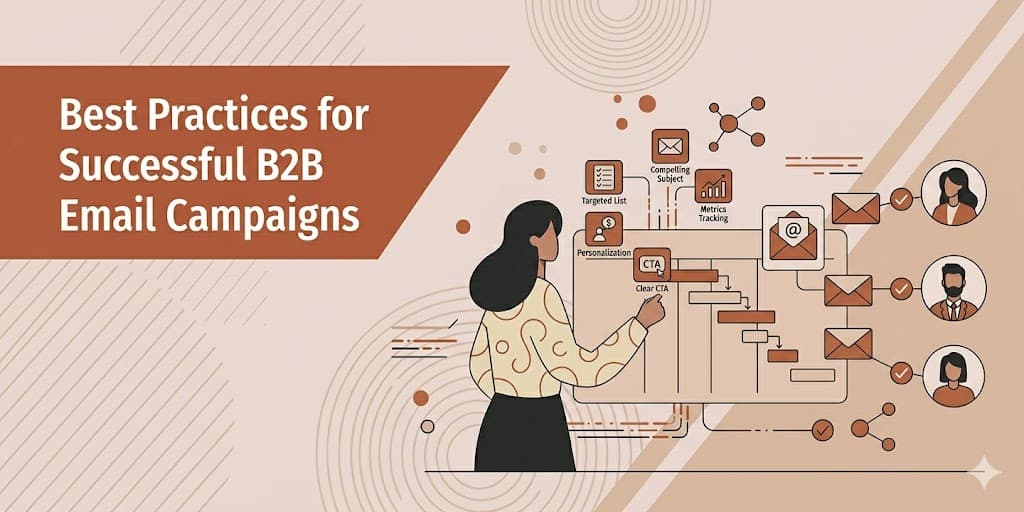
B2B buyers make purchasing decisions about emails in under three seconds, and most marketing messages fail to engage. Traditional approaches like generic messaging and mass distributions are easily spotted and deleted by experienced professionals. However, strategic email remains highly effective, delivering strong returns when executed properly — for every $1 spent, email marketing delivers $38 in return.
Why B2B Email Campaigns Deliver ROI
- Build Trust and Credibility — email provides direct audience access for consistent value delivery; thought leadership content, customer success stories and testimonials establish credibility over time
- Direct Engagement Across the Funnel — email reaches prospects' inboxes directly, enabling highly focused, timely, and personalized communication at every journey stage
- High ROI — few marketing channels match email's financial performance when properly implemented, delivering measurable, scalable results without substantial budgets
The Metrics That Matter
- Open Rate — measures how many recipients accessed your message; industry averages: Retail 38.59%, B2B Services 39.48%, SaaS 38.14%
- Click-Through Rate (CTR) and Click-to-Open Rate (CTO) — reveal content engagement after opening; industry averages: Retail 1.34%, B2B Services 2.21%, SaaS 1.91%
- Conversion Rate — tracks how many recipients complete desired actions, connecting email efforts to measurable business outcomes
- Bounce Rate — high bounce rates indicate list quality issues; regular list maintenance protects deliverability
- Delivery Rate — foundational metric reflecting how many messages successfully reached inboxes
Timing Your Sends for Maximum Impact
Send timing significantly impacts engagement. Tuesday through Thursday typically offer the highest engagement as professionals settle into the workweek. Avoid Mondays (congested inboxes) and Fridays (declining attention). The 8-10 AM time window often performs well, though audience characteristics, sector, and location affect optimal timing.
Proven Best Practices for B2B Email Success
- Start With Strong Subject Lines — keep them brief (under 25 characters frequently performs best), address clear business challenges, and apply light customization to spark interest
- Know Your Audience and Segment Intelligently — effective segmentation considers professional title, sector, buyer journey stage and decision-making role; segmented campaigns enjoy 14% higher open rates
- Personalize Deeply — customization extends beyond names; utilize geography, previous interactions, professional role and journey stage; personalized emails see 26% higher open rates and generate revenue 5.7x higher
- Embrace A/B Testing — continuous iteration tests subject lines, CTAs, designs and delivery times
- Keep Copy Clear and Concise — format copy for easy scanning using short sections, bullet points and highlighted essential information
- Use Actionable, Singular CTAs — each message should direct readers toward one specific next action using prominent buttons with time sensitivity
- Test Plain Text Formats — plain text conveys authenticity and personal connection; compare both versions
- Expand Reach With Third-Party Partnerships — collaborate with industry groups and media outlets to access high-value audiences outside your immediate network
- Set Benchmarks and Monitor Progress — establish baseline performance and monitor against past performance and sector standards
Turning Metrics Into Actionable Insights
Performance data provides direction for enhancement rather than static reporting. Reduced open rates? Examine subject line quality and list condition. Weak click performance? Reassess calls-to-action or message structure. Elevated bounces? Perform list cleaning. Testing identifies effective strategies, while precise targeting enables increasingly customized optimization.