

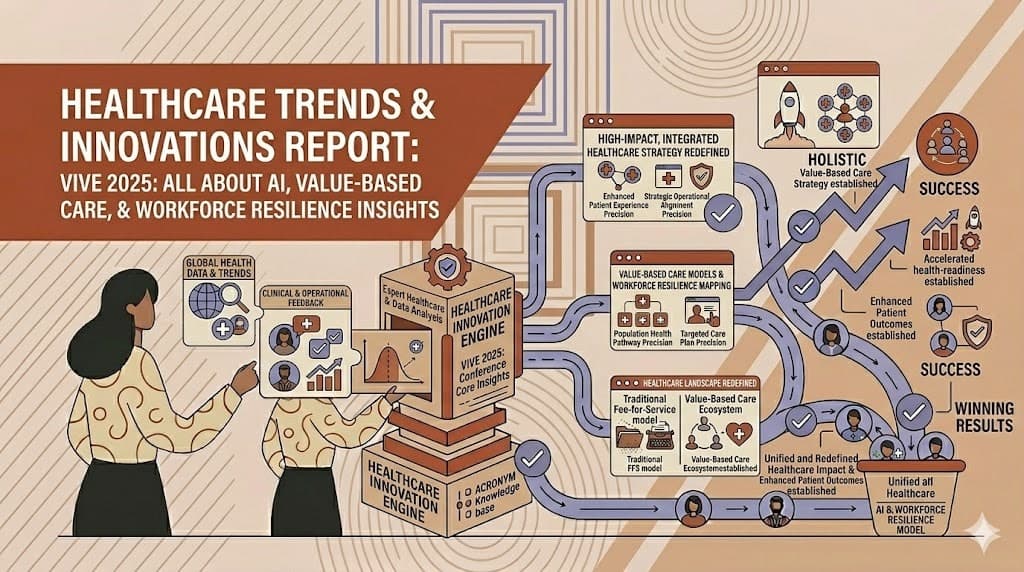
Attending ViVE 2025 was an eye-opening experience that offered a compelling glimpse into the future of healthcare. Three key themes stood out to me: the rapid evolution of artificial intelligence, the ongoing challenges and opportunities in value-based care and the urgent need for workforce resilience.
Conversations with industry leaders and innovators made it clear that these forces are reshaping healthcare in real time — and the path forward is both exciting and complex.
AI in Healthcare: Moving Beyond the Hype
Last year, AI was a hot topic. This year, it's a driving force that's reshaping healthcare, with real-world applications for improving diagnostics, clinical documentation and patient outcomes.
One of the most discussed innovations at this year's event was ambient AI — technology that listens, transcribes and streamlines workflows in the background. It was even used at ViVE to transcribe sessions in real time.
Seeing ambient AI in action reinforced how much the technology can reduce the administrative burden on healthcare providers. Rather than spending hours on documentation, doctors can now focus more on patient care.
Similarly, the impact of AI-driven medical notetaking is undeniable. Abridge, a generative AI startup, announced a massive $250 million Series D funding round at ViVE. Their AI technology transforms doctor-patient conversations into structured clinical notes that integrate with health records in real time. It's a game-changer for the over 100 U.S. health systems already using it.
Predictive analytics is also evolving rapidly, with AI now helping detect early signs of patient deterioration and predict falls. However, these advancements present challenges that need to be addressed, including ethical concerns, a lack of validated data and the need for robust governance.
Yet, despite AI's promise, a degree of skepticism remains about its practical implications. A recurring theme at ViVE was that AI should support clinicians, not replace them. It's crucial to distinguish between truly impactful AI-driven solutions and overhyped technologies that fail to deliver tangible improvements to patient care or healthcare teams.
Value-Based Care and Healthcare System Transformation
The transition to value-based care (VBC) continues, but it's far from a smooth journey. The industry is striving to align incentives, improve access to quality care and reduce costs, but scaling these models is proving difficult.
Adoption of VBC has remained uneven, with major hurdles in specialty care integration, provider engagement and financial sustainability. Many organizations are struggling to balance the long-term benefits of VBC with the immediate pressures of financial stability.
Technology is helping ease some of these challenges. Intelligent triage systems and ambient clinical assistants are reclaiming valuable time for providers, reducing burnout in the process. Some providers have reclaimed as much as 35 minutes per day and significantly reduced their administrative workload.
At ViVE, Lumeris, a value-based care company, announced the launch of "Tom", an AI-powered tool designed for primary care doctors. Tom provides personalized, next-best actions at both patient and population levels.
But technology alone isn't enough. Patient engagement remains one of the greatest barriers to success. Even with the most advanced digital tools, incentivizing patients to become more actively involved in their own care is still a challenge.
Workforce Resilience and Change Management
Another challenge discussed at ViVE was the ongoing struggle to recruit, retain and engage healthcare workers. Burnout and staffing shortages continue to plague the industry, making workforce resilience a top priority.
Today's health systems are rethinking their hiring strategies. Rather than focusing solely on technical skills, many are prioritizing cultural fit and mission alignment. The idea is that while technical skills can be learned, a deep commitment to patient care and organizational values is much harder to teach.
I was particularly inspired by the talent development programs gaining traction. For example, Seattle Children's is partnering with local colleges to create internal talent pipelines for healthcare and IT professionals. This kind of initiative not only fills staffing gaps, but also provides clear career pathways, encouraging long-term retention.
It's also clear that technology adoption involves more than how advanced the technology is — it's about how well it's introduced and integrated into existing workflows. That's where change management comes into play. Ultimately, many healthcare providers remain skeptical of digital solutions, especially when it comes to electronic health records and AI-driven documentation tools. Overcoming this resistance will require careful planning, continuous education and a clear demonstration of the benefits.
The Future of Healthcare: Are We Ready?
ViVE 2025 highlighted the fact that healthcare is at a turning point. AI, value-based care and workforce transformation are not just trends — they are essential to the future of the industry. Organizations that embrace innovation while prioritizing governance, financial sustainability and workforce resilience will be best positioned for success.
The future is being shaped now, and those who act with intention and agility will lead the way. Want to learn more about how Kubnal Bridge supports healthcare brands? Get in touch with our team today.