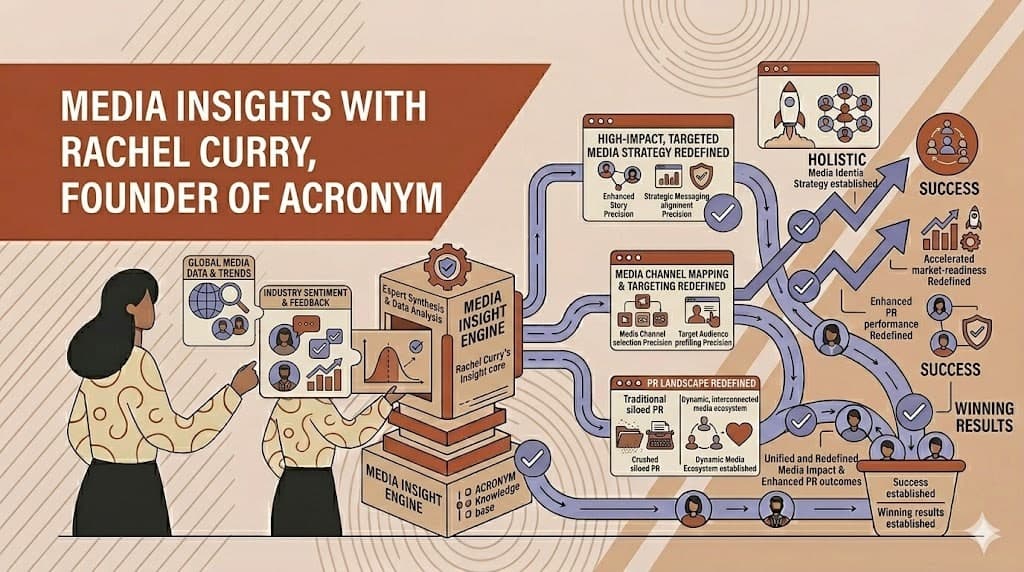
Rachel Curry is a freelance tech and business journalist with work featured in CNBC, Observer, CIO and beyond. In December, Rachel launched her own newsletter, Acronym, that aims to tell impactful stories without the legacy media guardrails in a way readers from various backgrounds, not just the tech executive, can understand.
Independent media and newsletters like Acronym are gaining momentum as newsrooms continue to adjust and consumers crave more transparency in the media they consume.
To better understand this shift, Rachel joined me in the interviewee seat for once, where I asked her some questions about her inspiration behind Acronym, how she's actively building a community among her readers at both traditional and non-traditional media outlets and her predictions for how independent newsletters like Acronym will evolve in the near future.
What was your inspiration for starting Acronym?
Curry explained her desire to use accessible language and a more relatable tone while maintaining journalistic integrity. She noted that allowing herself editorial moments at the conclusion of pieces provides value without compromising standards.
You mention your audience. Who do you want to read Acronym and how do you plan on continuing to build that community?
Curry aims to bridge gaps between business professionals at various levels, from bootstrapped entrepreneurs to C-suite executives. She emphasizes making content culturally relevant and reducing reliance on industry jargon that exhausts even experienced readers.
Tell me more about the reason behind the name Acronym.
The newsletter name originated from observing that her article concepts naturally formed acronyms. Curry reflected on her early career experiences entering executive circles despite lacking formal credentials, describing it as learning a new language while wearing a professional costume.
As an independent journalist, you have the freedom to write whatever you want. Will you stick to one specific topic?
While hesitant to pigeonhole the newsletter with labels, Curry gravitates toward workplace and future-of-work topics because they directly impact people's lives. She integrates perspectives on broader societal implications across all content.
Regarding idea generation, Curry sources stories from reader submissions, past contacts, and outreach through platforms like LinkedIn and Qwoted. She reports strong receptiveness from potential interviewees despite the newsletter's independent status.
How do you anticipate the rise of non-traditional media to evolve in the next 12 months?
Curry observes that non-traditional media consumption is expanding beyond journalism enthusiasts. She anticipates independent publications will establish stronger reader bases and organizational stability while legacy outlets continue experimenting with omnichannel strategies and subscription models.
"I personally feel, and know a lot of other people feel, given the state of the economy, really exhausted by subscriptions."
Curry plans to avoid paywalls, instead focusing on building reader trust and pursuing non-invasive advertising revenue. She views long-term community development as more valuable than immediate monetization.
How have you been working with PR people for Acronym?
Curry notes that PR collaboration for Acronym mirrors her traditional media work, with added flexibility on deadlines and story angles. She appreciates communications from PR professionals and occasionally seeks sources through platforms like LinkedIn and Qwoted when needed.