
The digital discovery landscape is undergoing a fundamental transformation. AI-based systems like ChatGPT, Perplexity, Google Gemini, and Claude are shifting user behavior from "searching" to "synthesizing." This shift has created two distinct optimization disciplines: SEO and GEO.
What Is the Core Distinction?
Search Engine Optimization (SEO) focuses on ranking on traditional search engines like Google and Bing. Generative Engine Optimization (GEO) focuses on being cited and referenced in AI-generated responses. The fundamental shift represents movement from a "click economy" to a "citation economy."
- SEO Primary Goal: High SERP placement and click-through traffic
- GEO Primary Goal: Citation and reference as a trusted source in AI responses
- SEO Unit of Value: URL (Link)
- GEO Unit of Value: Information Fragment
- SEO User Interaction: Click visit to site
- GEO User Interaction: Zero-click reading within AI response
- SEO Success Metric: Ranking, traffic, CTR
- GEO Success Metric: Citation frequency, sentiment score
Metric and KPI Comparison
Traditional SEO metrics require evolution for the AI era. The framework shifts from "What rank am I?" to "How often does AI cite me?"
- Visibility: Organic ranking position (SEO) vs. citation frequency in AI responses (GEO)
- Traffic: Organic volume (SEO) vs. zero-click reach and impressions (GEO)
- Engagement: Click-through rate (SEO) vs. Share of Model — SoM (GEO)
- Authority: Domain authority and backlinks (SEO) vs. entity association (GEO)
- Conversion: ~2.8% organic rate (SEO) vs. ~14.2% AI-referred rate (GEO)
AI-referred traffic demonstrates five times higher conversion rates compared to traditional organic traffic, despite lower volume.
Share of Model (SoM) measures the percentage of category questions where AI recommends your brand. Sentiment Score evaluates how AI describes your brand's tone and trustworthiness.
Technical Requirements Comparison
AI engines require different technical foundations than traditional search engines. While SEO relies on Googlebot and Bingbot access, GEO requires access for GPTBot, ClaudeBot, and PerplexityBot.
- Bot Configuration: robots.txt for SEO; robots.txt + llms.txt + agent-permissions.json for GEO
- Structured Data: Basic Schema.org for SEO; advanced Schema.org with detailed JSON-LD for GEO
- Page Rendering: Client-side acceptable for SEO; server-side rendering mandatory for GEO
- Speed Metric: Core Web Vitals for SEO; context window optimization for GEO
Client-side sites built with JavaScript cannot be read properly by LLM crawlers, making server-side rendering essential for GEO.
The llms.txt file functions as an AI version of robots.txt, guiding AI systems to your most essential and authoritative content.
Content Strategy Comparison
Content must evolve to provide verifiable information fragments rather than keyword-focused material.
- Headline Format: Keyword-focused for SEO; question format for GEO
- Intro Paragraph: Hook/attention-grabbing for SEO; direct answer for GEO
- Statistics: Optional for SEO; critical for GEO (+35–40% visibility boost)
- Source Citations: Internal/external linking for SEO; credible source mandatory for GEO
- Expert Opinion: Content enrichment for SEO; high-entropy anchor for GEO
- Keyword Usage: Stuffing is risky in SEO; stuffing actively harms GEO (−10%)
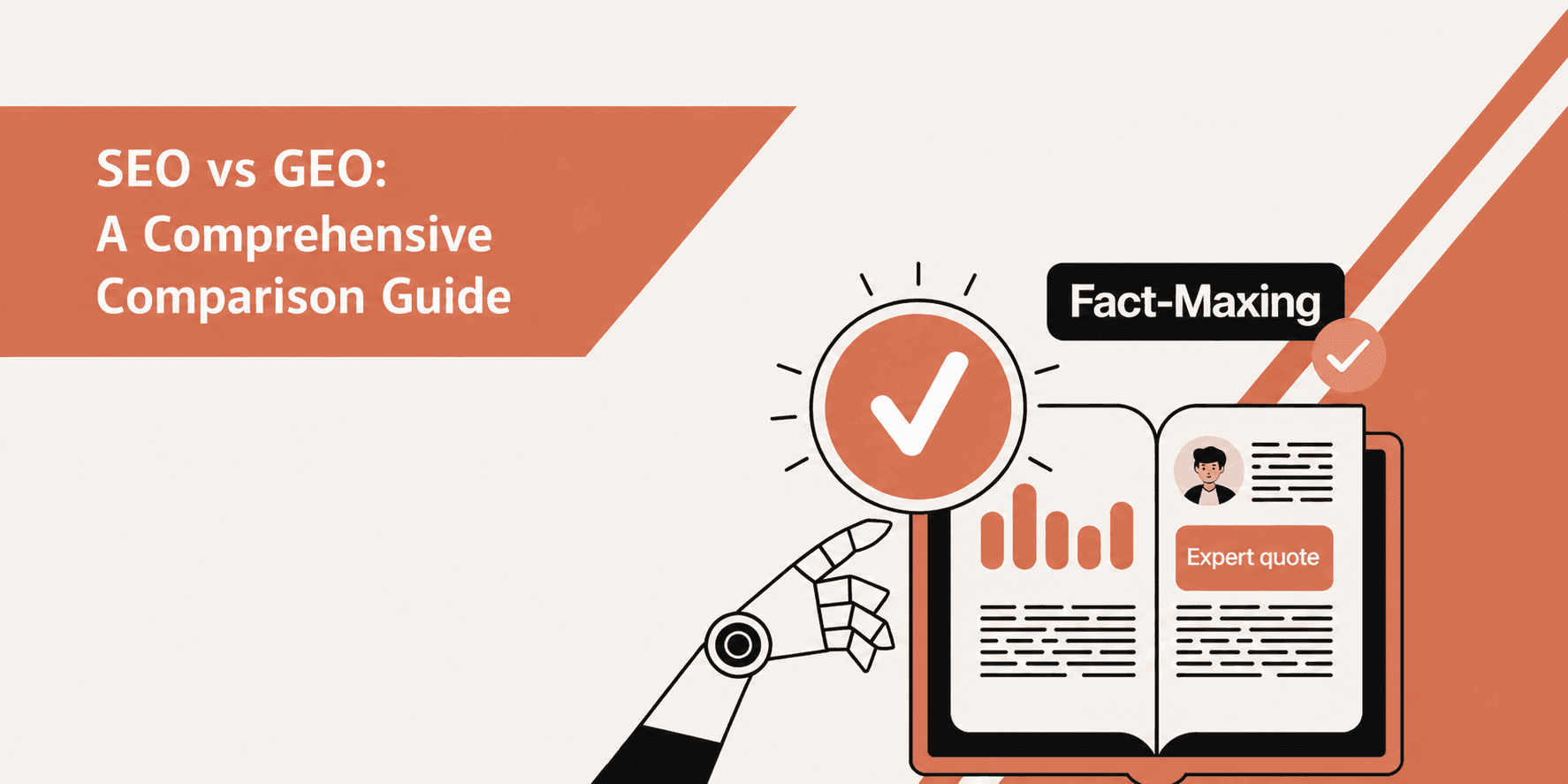
The Fact-Maxing Principle: Convert ambiguities into concrete data. Replace "our experienced team" with "47 team members averaging 8 years of experience." Specific, verifiable claims make AI more likely to cite your content.
GEO-Bench Optimization Data
The GEO-Bench study from Princeton University, Georgia Tech, and the Allen Institute for AI analyzed 10,000 queries to measure effective content strategies for AI visibility.
- Citing Sources: +30–40% GEO visibility improvement
- Expert Quotations: +30–40% GEO visibility improvement
- Adding Statistics: +35–40% GEO visibility improvement
- Authoritative Tone: Moderate positive impact
- Fluency Optimization: Moderate positive impact
- Keyword Stuffing: −10% GEO visibility (harmful)
The golden trio of GEO strategies — citations, expert quotes, and statistics — provides substantial visibility improvements by offering verifiable information that reduces AI hallucination risk.
Sectoral GEO Strategy Differences
Different industries require customized GEO approaches.
- SaaS/B2B: Focus on "Definition Ownership" — produce original statistics that industry leaders cite
- E-Commerce: Implement dynamic schema with real-time stock and price data to prevent AI recommending unavailable products
- Health/YMYL: Prioritize consensus and credibility through medical institution alignment and expert signatures
- Science/Tech: Emphasize statistics and technical terminology
- Lifestyle: Focus on fluency and clear, accessible language
Zero-Click Realities and Traffic Impact
Zero-click searches significantly impact traffic dynamics in the age of AI search.
- Zero-Click Rate: ~60% without AI Overviews; ~83% with AI Overviews active
- CTR Impact: −34.5% to −49% drop when AI Overviews appear
- Conversion Quality: AI-referred traffic converts at ~14.2% vs ~2.8% for standard organic
- 2026 Forecast: Gartner predicts a 25% decline in total search volume
The strategic choice is clear: pursue high-volume, lower-quality traditional traffic, or low-volume, high-quality AI-referred traffic. Most successful brands will pursue both simultaneously.
GEO Tool Ecosystem
- Analytics: Profound, Goodie AI for AI citation tracking
- Rank Tracking: Profound, georanker.com for AI visibility monitoring
- Brand Monitoring: Peec AI for real-time ChatGPT brand mentions
- Combined Solutions: Evertune, LLMrefs for hybrid SEO+GEO tracking
- Traditional Tools Adapting: Ahrefs Brand Radar, SEMrush AI Toolkit
Future Trends: Action Engines and the Agentic Web
The next evolution moves beyond information provision. AI systems are becoming action engines — capable of executing transactions, bookings, and purchases on behalf of users. This creates entirely new optimization requirements.
- AutoGEO: Industrial-scale content production through automated LLM content rewriting systems
- Action Engines: AI that executes transactions — bookings, purchases, appointments — requiring API optimization
- Agent Optimization (AO): Structured data and API integration so AI can make sales on your behalf
- AP2 Protocol: Emerging AI purchasing protocols for e-commerce
Conclusion: The New Equation of Digital Visibility
SEO and GEO are not substitutes for each other — they must work together. Digital visibility now means being encoded as a correct, reliable, and referenced entity in the AI's modeling of the world.
- Hybrid Strategy: Continue SEO for traffic while building GEO authority for reputation and conversion
- Data-Driven Content (Fact-Maxing): Shift from opinion to original data with structured schema implementation
- Agent Era Preparation: Build infrastructure for autonomous AI agents beyond current visibility goals
Correct GEO strategies increase brand visibility in AI responses by up to 40 percent. The winning golden trio — statistics, source citations, and expert quotations — provides the highest impact.