

A go-to-market (GTM) strategy provides the structure your team needs to bring a product or service to market successfully. Without a clear plan, marketing, sales and product teams can struggle to stay aligned, leading to inefficiencies and missed opportunities.
The right GTM strategy helps you define your approach, create messaging that resonates with your audience and establish processes that drive measurable outcomes. Whether your goal is increasing brand awareness, generating demand or improving conversion rates, a well-structured GTM strategy provides a roadmap to execute with confidence.
What is a GTM Strategy?
A GTM strategy is a comprehensive plan for how your company introduces and sells a product, service or campaign to a specific market. It covers the tactics, audiences, messaging and metrics that guide your team's execution from launch through growth.
A well-structured strategy answers key questions, including:
- What is the ideal customer profile (ICP)?
- What unique value does the product or service offer to the target audience?
- How will the company engage and convert buyers?
- What metrics define success?
Without this foundation, teams risk misalignment, wasted resources and inconsistent messaging. A clear GTM strategy brings the clarity needed to engage the right audiences and drive measurable impact.
Key Elements of a Comprehensive GTM Strategy
A successful GTM strategy aligns teams and creates a foundation for long-term execution. Here are the core components every strategy should include:
Market analysis
A strong GTM strategy starts with a clear understanding of your target market. This includes identifying industry trends, competitor positioning and shifts in customer behavior. Thorough research helps teams make data-driven decisions rather than relying on assumptions.
Value proposition
Your value proposition defines why customers should choose your solution over competitors. A strong GTM strategy ensures messaging highlights the outcomes customers care about most — whether that's efficiency, cost savings, security or revenue growth.
Sales and marketing alignment
For a GTM strategy to succeed, sales and marketing must operate as a unified revenue engine. By defining lead qualification criteria and a structured handoff process, you can prevent inefficiencies and improve sales pipeline performance.
Clearly defined objectives
Your GTM strategy should focus on objectives that support meaningful business outcomes. While metrics like brand awareness and lead volume matter, your goals should ultimately connect to the "why" behind those metrics: What are you looking to accomplish for the business?
Adaptability
Market conditions change quickly. Your GTM strategy should be flexible enough to evolve with them. Reviewing strategy performance quarterly allows you to refine messaging, shift tactics and stay aligned with audience needs.
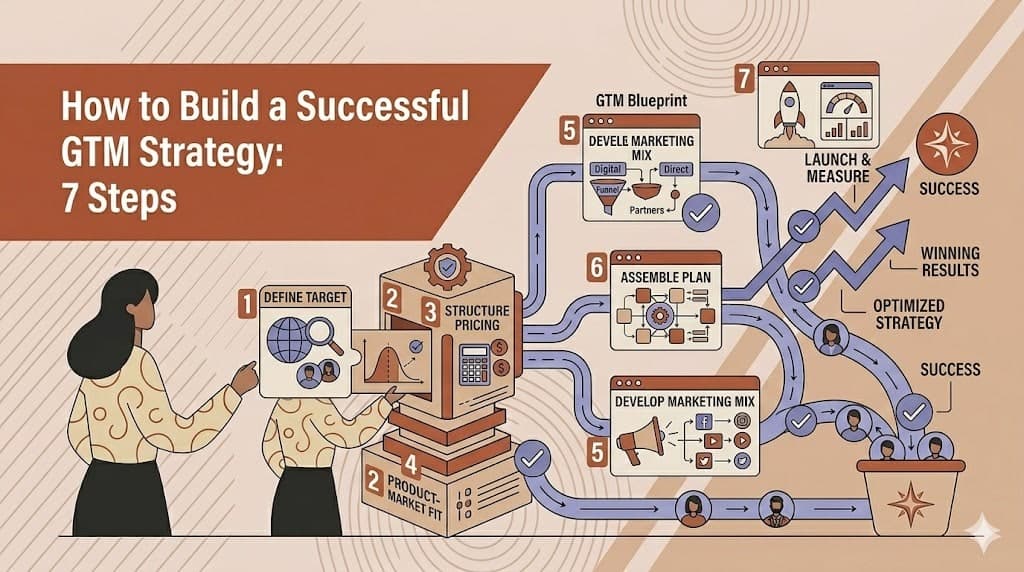
7 Steps for Building a Successful GTM Strategy
1. Conduct market and risk analysis
Before launching a GTM strategy, assess customer demand, competitor positioning and potential risks. This research ensures your team makes informed decisions rather than reacting to market challenges as they arise.
2. Define your ideal customer profile
An ICP helps teams focus on high-value prospects who are most likely to buy, renew and expand. A well-defined ICP includes details on industry, company size, key decision-makers and pain points, ensuring sales and marketing target the right audience personas.
3. Map the customer journey
Understanding the customer journey allows teams to engage buyers at the right time with the right messaging. This step helps align marketing campaigns, sales outreach and customer support with how buyers move from the awareness phase to the purchase phase.
4. Build the messaging
Create a brand messaging framework that outlines your brand story, key differentiators and value props for each audience segment.
5. Set the channel strategy
Determine the best channels to reach and convert your target audience. Consider where your ICP spends time and how they prefer to engage with brands — whether through digital ads, social media, in-person events or another channel.
6. Align the sales and marketing process
An effective marketing strategy aligns with the sales process and the customer journey, ensuring sales reps have the sales enablement tools and materials they need for impactful prospecting, qualification and deal closure.
7. Define measurable KPIs
Tracking lead conversion rates, sales velocity and other measurable KPIs provides insight into GTM effectiveness, helping teams refine execution strategies.
8. Optimize your GTM strategy based on performance
Use real-time data and customer feedback to refine your GTM execution. Revisit goals, update messaging and shift tactics as needed.
Why Cross-Department Alignment is Critical for GTM Success
Marketing, sales and customer success departments must work together to ensure a seamless customer experience. When teams operate in silos, messaging becomes inconsistent, lead handoffs break down and revenue potential decreases.
A strong GTM strategy establishes shared goals, aligned messaging and a structured feedback loop, improving lead conversion rates and long-term customer retention.
An Outcomes-Based Approach to Developing Your GTM Strategy
At Kubnal Bridge, we take an outcome-based approach (OBM) to GTM strategy. We help B2B brands develop custom GTM plans that help you achieve your North Star business objectives and drive measurable revenue impact.
From market research and messaging strategy to digital marketing and sales enablement, we ensure that every aspect of your GTM plan is built for execution. Let's talk about how we can build a GTM strategy tailored to your business goals.
FAQs about GTM Strategies
What KPIs should be tracked for a GTM strategy?
KPIs should depend on your business goals. A few examples may include tracking pipeline growth from specific ICP segments, lead conversion rates, brand perception, engagement with various audiences or marketing ROI and customer acquisition costs.
What are some common mistakes to avoid when building a GTM strategy?
Companies often fail to define their ICP, align sales and marketing or set measurable goals. Without a clearly defined target audience or goals, measuring the success of your GTM strategy can be challenging.
How often should a GTM strategy be updated?
GTM strategies should be reviewed quarterly and adjusted based on performance data and market shifts.
Are there industry-specific GTM strategies?
Yes, GTM strategies vary by industry based on factors like customer behavior, sales cycles and competitive landscapes.
Who should use a GTM strategy?
Any business launching a new product, entering a new market or optimizing sales and marketing alignment can benefit from building a structured GTM strategy.